

Korean-Made Lifting Devices to Try on Your Trip to Korea(2026 Guide) Planning skin treatments in Korea? Compare 5 Korean lifting devices — Shurink, LinearZ, Volnewmer, Density and Corege 2.0
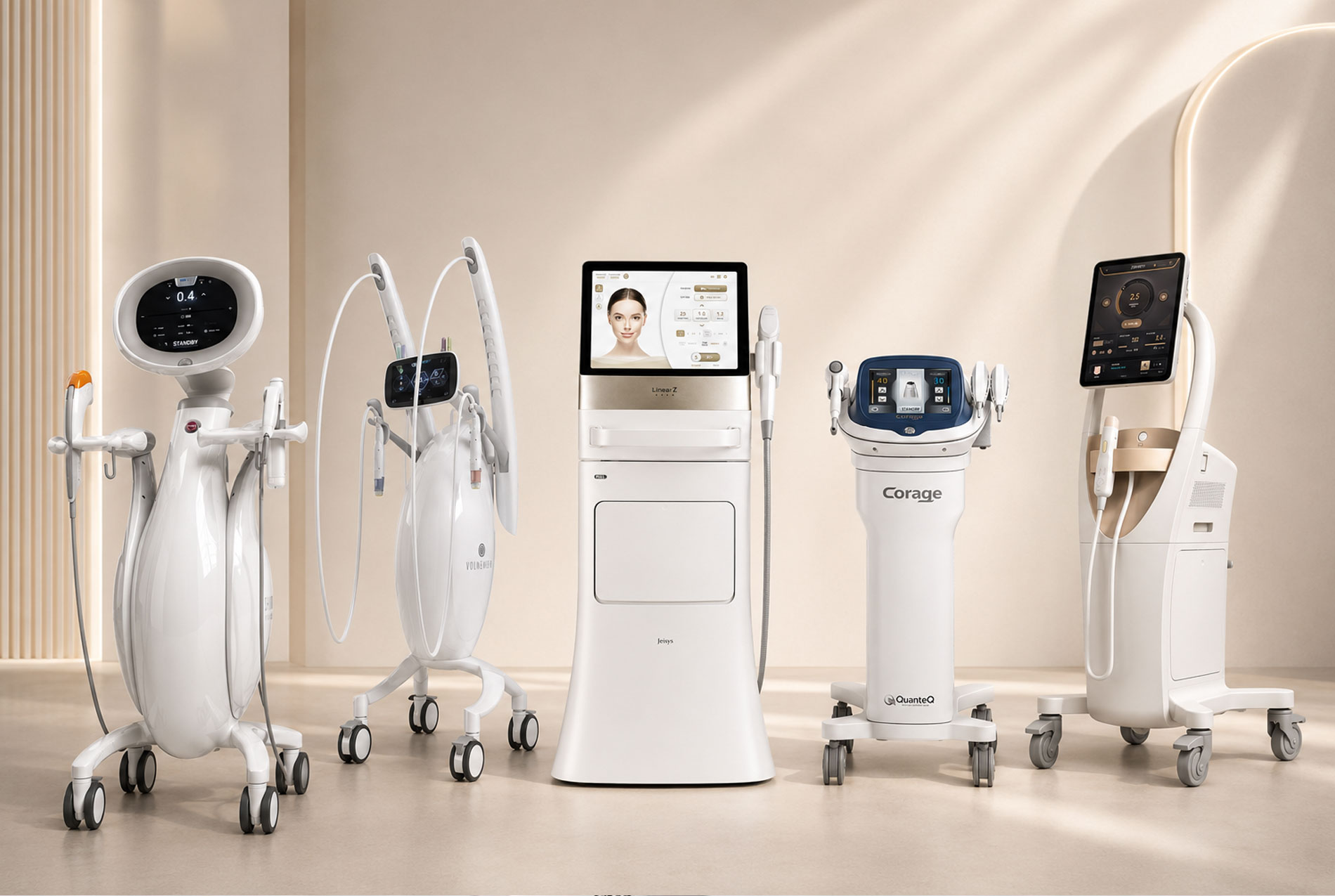
Korea is well known for developing and manufacturing a wide range of aesthetic medical devices. Where imported devices such as Ulthera and Thermage once set the standard, recent years have seen Korean-made devices — built on the same principles but generally more affordable — become widely used. This guide covers five of the Korean-made lifting devices commonly used in Korea as of 2026: Shurink, LinearZ, Volnewmer, Density, and Corege 2.0, along with how each one works.
This article is for informational purposes only. Whether a treatment is suitable for you, and which method is appropriate, can only be determined after an in-person consultation with a physician.
A Quick Primer: How Lifting Treatments Work
Non-surgical lifting devices generally fall into two categories.
- Ultrasound (HIFU, High-Intensity Focused Ultrasound). Ultrasound energy is focused on a single point beneath the skin to create thermal coagulation points; the heat contracts tissue and stimulates collagen regeneration. A key strength is that it can reach deep layers, including the SMAS (the fibromuscular layer). Ulthera is the device best known for this approach.
- Radiofrequency (RF). RF energy meets the skin's natural electrical resistance and generates heat, which coagulates and contracts tissue in the dermis to improve firmness. It tends to deliver heat more broadly across an area. Thermage is the device best known for this approach.
Neither approach is universally "better." The right one depends on how much sagging you have, your skin thickness, and the area of concern — and the two are sometimes combined.
Shurink — Affordable Ultrasound Lifting
Shurink is a HIFU (ultrasound) lifting device made by the Korean medical device company Classys, and it's one of the most widely recognized lifting treatments in Korea. Built on the same principle as the ultrasound lifting represented by Ulthera, this Korean-made device tends to carry a comparatively lower cost, which makes it a common entry point.
How it works and what it does
Ultrasound energy is focused at set depths beneath the skin to form tiny thermal coagulation points, and this stimulus encourages collagen to reorganize and regenerate. Because treatment depth can be divided across layers — from the dermis down to the SMAS — it can help improve sagging contours and reduced firmness. Newer versions add a linear delivery mode alongside the conventional dot mode, allowing denser coverage in certain areas.
It can be done in a relatively short time and tends to have quick downtime, which is why it's often chosen as a lifting treatment to try at least once in Korea.
LinearZ — Ultrasound Lifting Using Both Lines and Dots
LinearZ is a HIFU lifting device made by Jeisys Medical, and it's an upgraded version of the earlier "Linear Firm." Like Shurink, it uses the Ulthera-family ultrasound principle, but it differs in how the energy is delivered.
How it works and what it does
Where conventional HIFU delivered energy only in a dot pattern, LinearZ uses both a linear and a dot mode to deliver energy more quickly and densely. It uses focused ultrasound energy at around 7 MHz, and a single cartridge allows the mode and depth to be adjusted for layer-specific treatment. Depths can be set across a wide range, from the shallow layers around 1.5 mm down to roughly 13 mm.
Because the linear delivery tends to involve less discomfort, treatment is sometimes performed with reduced reliance on anesthesia. It's used broadly — for firmness and wrinkle improvement, jawline and deep-cheek contouring, and delicate areas such as the brows and around the eyes. That said, the level of discomfort and the results vary from person to person.
Volnewmer — Monopolar RF in the Thermage Family
Volnewmer is a monopolar radiofrequency (RF) device made by Classys — a Korean-made device in the monopolar RF category represented by Thermage. It's an MFDS-approved medical device and uses thermal RF energy at around 6.78 MHz.
How it works and what it does
When RF energy is delivered through a monopolar electrode, the skin's electrical resistance generates heat, coagulating tissue in the dermis. This process promotes collagen production and can help improve firmness, fine lines, skin texture, and pores.
Tip selection
Volnewmer offers four tip types (I, V, F, and S) chosen according to the treatment area, and the tip head tilts a full 360 degrees so it can stay in close contact with the curves of the face for more precise treatment. It also features a cooling system that runs continuously during treatment and an impedance-checking function that reads each person's skin resistance to adjust the energy. It's an approach where deeper thermal stimulation supports firmness improvement that develops over time.
Density — RF That Combines Monopolar and Bipolar
Density is also a Thermage-family RF lifting device, but its distinctive feature is that it uses both monopolar and bipolar RF in a single device. It delivers 6.78 MHz RF energy at a high output of up to 400 W.
How it works and what it does
Monopolar energy is directed to the deeper layers and bipolar energy to the shallower layers, alternating within a single shot so that energy is distributed evenly across multiple skin layers. The delivered heat induces collagen and elastin production, so you can look for both the immediate tightening felt right after treatment and the firmness improvement that develops over time. It's used for tightening, wrinkle improvement, and pore refinement.
Tip selection
Density lets you adjust treatment intensity and depth through its tips:
- Classic tip — delivers monopolar RF only, with an emphasis on longer-term firmness in the deeper layers.
- High tip — delivers both monopolar and bipolar RF.
- Alpha tip — delivers monopolar and bipolar RF over a wider, deeper area.
With a total of seven tips, treatment can be tailored from narrow to broad areas, while a five-level cooling system and impedance feedback help protect the skin. If you're sensitive to pain, the cooling level can be adjusted to ease the discomfort. In other words, the ability to choose your tip — monopolar alone, or monopolar plus bipolar — is a key point to note when comparing Density with Volnewmer.
Corege 2.0 — A Four-Step Combination Lifting Using Resonance Waves
Corege 2.0 works somewhat differently from the devices above. Rather than applying heat to the dermis with a single wavelength of RF, its core feature is the use of multiple resonance waves (resonance energy).
How it works
Corege uses 16 types of resonance energy delivered directly to skin cells and extracellular material to support cell activation and regeneration. In simple terms, it's less about coagulating tissue with heat and more about stimulating the cells themselves to grow stronger. For this reason, it's often noted that treatment can be performed with considerably reduced discomfort.
A step-by-step combination using multiple handpieces
Corege 2.0 uses several handpieces in sequence, so a single session can be built into multifaceted care. It's generally performed in the following order:
- Plasma Roller — using fractional resonance energy together with a plasma effect, it helps shed aged fibroblasts and induce regeneration of new fibroblasts. It's used for depressed (atrophic) scars and for improving complexion and skin texture.
- Applicator (RF tip) — delivers resonance energy across an area to refine overall firmness and skin condition.
- Egg Lifting — a handpiece newly added in the 2.0 version, focused on firming skin that has sagged overall.
- Glove RF — in the finishing step, it delivers energy evenly across a broad area for an all-over finish.
Because the handpieces are applied in sequence, you can look for the possibility of addressing several concerns — scars, firmness, and contour — in a single visit while keeping discomfort lower. That said, the degree of benefit and the right combination of steps depend on your individual skin condition.
Which Device Should You Choose?
The starting point is always: where is my concern?
- If deep-layer sagging or contour lines are the issue — consider the ultrasound (HIFU) devices that reach the SMAS, namely Shurink and LinearZ. Both are Korean-made devices using the Ulthera-family principle and tend to be comparatively affordable.
- If overall loss of firmness, skin texture, or pores is the issue — RF approaches such as monopolar Volnewmer or the monopolar-plus-bipolar Density are commonly used. If immediate tightening and a wider range of tip options matter to you, Density is an option; if you want the deeper stimulation of monopolar alone, Volnewmer is a choice.
- If you want to minimize discomfort while addressing several concerns at once — consider Corege 2.0, with its step-by-step resonance-wave combination care.
Ultrasound and RF are sometimes received together, so the final plan is best decided after a consultation with a physician.
Side Effects and Precautions to Know Before Treatment
Non-surgical lifting devices tend to have relatively quick recovery, but as with any medical procedure there is a possibility of side effects, so it's important to understand them going in.
- Temporary redness, swelling, flushing, or mild bruising may appear after treatment and usually settles within a few days.
- You may feel pain or a sensation of heat during or after treatment; the degree varies with your skin condition and pain sensitivity.
- Rarely, burns, pigment changes, or temporary sensory changes from nerve stimulation may be reported.
- For about a week after treatment, it's best to avoid alcohol, saunas, heat therapy, and strong sun exposure, and to pay attention to moisturizing and sun protection.
- Treatment may be restricted in certain cases — for example, active skin inflammation or infection, pregnancy or breastfeeding, or implanted metal or electronic medical devices.
Both benefits and side effects vary from person to person, and the above is general information. Be sure to tell your physician about your health status, medications, and medical history at the consultation; whether treatment is appropriate, and which method to use, must be determined through an in-person examination.
FAQ
Discover Korean Skincare Treatments
Browse Seoul's transparent-pricing clinics and treatment guides.
All Guides Find a Clinic